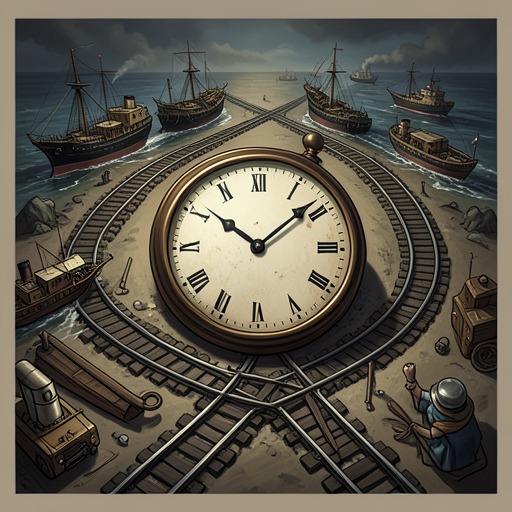
Passepartout’s family watch
Around the World in Eighty DaysPassepartout’s family watch gives a personal, pocket-sized form to the novel’s larger contest over time: whether a journey can be governed by precise clocks, and what those clocks fail to measure. Kept on London time as its owner crosses the globe, it becomes at once a source of comic confidence and an incomplete instrument. Its hands can mark hours and minutes, but not the gained day that turns Phileas Fogg’s apparent lateness into victory.
Inherited Object and Daily Precision
The watch is identified as Passepartout’s family inheritance, though the narrative gives no account of its earlier owners or physical appearance. Its importance comes instead from the faith he places in it. At the outset, Phileas Fogg’s household is organized around exact measurement: he dismisses James Forster because the shaving-water is four degrees too cool, watches a clock that registers seconds and calendar units, and keeps to a daily routine timed to the minute. Against that elaborate discipline, Passepartout’s inherited watch represents a more personal standard of time—one he trusts even when it differs from the clocks around him.
That difference appears early in the journey. When Fogg warns Passepartout not to miss the steamer, Passepartout checks his watch and protests that it is not yet noon but only eight minutes before ten. Fogg tells him the watch is slow. The brief disagreement establishes a practical consequence of relying on the family timepiece: its reading does not necessarily match the local schedule on which a departure depends. In a journey planned around transfers between trains and steamers, a discrepancy of hours is not merely a philosophical disagreement. It threatens the punctual connections on which the itinerary rests.
London Time on the Journey
Passepartout refuses to adjust the hands. He keeps the watch at London time and dismisses the local times encountered along the route as unreliable. That stubbornness makes the object a recurring counterpoint to the journey’s machinery. Fogg’s wager depends on moving through a world newly traversed by railways and steamships, and on joining those services with what he calls mathematical precision. The watch, by contrast, preserves a single reference point as the travelers move east across different places and meridians.
The contrast is especially sharp because the watch belongs to a story so attentive to measurement. The route is discussed in terms of minimum travel times, and Fogg accepts the need to move from trains to steamers without exceeding the calculated schedule. Yet the watch cannot by itself make those schedules agree. Its London setting provides continuity for Passepartout, not a reliable reading of the time in every place he visits. The book thus makes precision depend on what is being measured: an hour shown on a familiar dial, a departure in a particular port, or the elapsed days of a journey around the Earth.
The Antipodal Test
On November 23, after the party has left Yokohama, the General Grant crosses the 180th meridian and reaches the antipodes of London. By then Fogg has spent fifty-two of the eighty days allowed for the journey. At this point Passepartout discovers that, without having changed the hands, his watch agrees with the ship’s chronometers. He takes this as a triumphant vindication of his confidence in the family timepiece and recalls Fix’s explanations of meridians and the sun with derision.
The agreement is real, but Passepartout misunderstands what it establishes. The narrative explains that a twenty-four-hour dial would have shown nine in the evening rather than nine in the morning at that point, making visible the twelve-hour difference between London and the 180th meridian. Passepartout’s watch has only the ordinary division into twelve hours, so the same indicated hour conceals that distinction. Its apparent confirmation of his theory is therefore a comic reversal: he reads a limited coincidence as proof that the world has conformed to his watch.
The Day the Watch Cannot Count
The watch’s limitation matters decisively at the end of the journey. Traveling continuously east, Fogg has unknowingly gained a day. The book explains the calculation through the Earth’s 360 degrees: at four minutes for each degree crossed eastward, the accumulated difference is twenty-four hours. Fogg has seen the sun pass the meridian eighty times, while observers in London have seen it pass only seventy-nine times. Consequently, when he believes he has arrived in London on Saturday, December 21, it is actually Friday, December 20, the seventy-ninth day since his departure.
Passepartout’s watch could have revealed the discrepancy if it had marked days as well as hours and minutes. It keeps London time, but it does not record the altered relation between the travelers’ completed circuit and the calendar at home. This distinction separates clock-reading from date-keeping: the watch can preserve a familiar hour without telling its owner that the journey has added a whole day. Fogg wins his wager not because the watch has finally corrected itself, but because its limited display never exposes the fact in time. The inherited object therefore carries both the joke of Passepartout’s misplaced certainty and the precise mechanism of the ending’s reversal.